Apart from the many environmental benefits of no-dig gardening, the most obvious benefit of a no-dig system is of course there is “no digging” Woo Hoo!
For ever, people have been taught that in order to produce good crops they have to spend hours breaking their backs digging the soil, turning it over and pulling out every root they can find. The simple fact is that this is not true!
A much better alternative to traditional digging is no-dig growing. The drawback however, particularly on a new site, is the requirement for lots and lots of mulch in the form of composted organic matter. However, the benefits of mulching with compost far outweigh the benefits (if any) of digging, especially if you have a heavy clay soil.
If you are in your first year of creating a new garden it’s likely that you will be producing enough organic waste to compost for mulch. Even established gardens can struggle to produce sufficient compost for their own mulching needs for new beds.
Our solution to this is to buy in organic compost from a local recycling centre when we are planning a new site. Obviously there is a cost implication to buying in organic compost but we see it as an investment just the same as buying a polytunnel, tractor and tools.
So Why Mulch?
Apart from saving you a lot of time and hard work (and more importantly your back) unnecessarily turning over the soil, mulching with compost has many other benefits.

Mulching, rather than digging, means the ecology of the soil isn’t disturbed. Take a walk through any woodland, or look at areas of farmland not ploughed up, even plots of wasteland in towns and cities, and you’ll notice how well everything is growing. This is because the soil is working perfectly well without any interference from us clever gardeners.
Within the soil is a rich and complex matrix of organisms including insects, worms, bacteria and fungi all working together to break down and recycle organic matter, free up nutrients and nourish the roots of your precious plants.
Obviously woodland and wasteland don’t usually contain many of the plants we would want in our veg plots. In fact many of these plants are generally considered by most growers to be weeds. The point is that these places are highly productive systems fuelled by a healthy undisturbed soil ecosystem, which as permaculturalists is something we want to replicate, sans weeds of course.
Benefits Of Mulching With Compost
- No-digging.
- Can be laid directly on to most cleared land.
- Improves the ecology the soil.
- Improves spoil condition.
- Suppresses weeds.
- Provide a sterile bed for planting and sowing.
- Only needs a top dressing of fresh compost annually.
Negatives of Mulching With Compost
- Can be expensive in the first instance.
- Some work needed on new beds.
How We Make Our No-Dig Beds
Learning how to mulch your new beds effectively is often a matter of trial and error but it’s always good to hear what other growers have done, so here is how we mulch new beds.
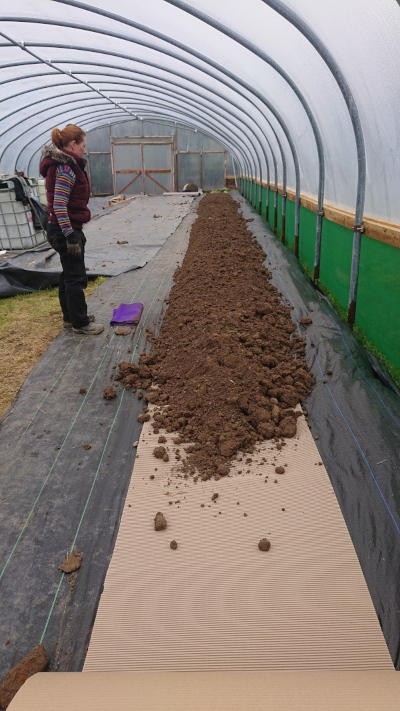
First we mark out the area we intend to make into a bed and then we cut down the existing plants to ground level. This makes it much easier for the next step which is covering the bed with cardboard. We then cover the cardboard with a thick layer of organic compost.
Some pointers based on our mistakes using cardboard and compost as a mulch:-
Check the moisture content and temperature of the ground before putting down the cardboard. Mulching with cardboard and compost is a great way to keep the moisture in the ground but it is equally as good at keeping it out.
The same applies to temperature. A thick layer of cardboard and mulch acts like a duvet. If the ground is bone dry and scorching hot or waterlogged and freezing cold before you mulch, that’s how it will remain for long enough to kill off any seeds or seedlings you plant.
Always overlap the cardboard more than you think you need to. It’s amazing how persistent some weeds like nettles, thistles and brambles can be and how far they can squeeze between the overlaps.
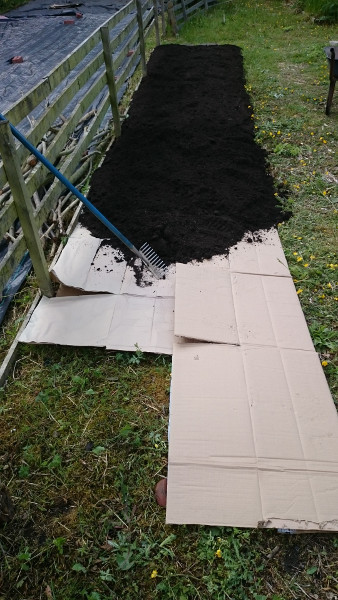
Use a thicker layer of compost than you think you need. If the mulch is too thin then any weeds that do make it through the cardboard can easily find their way to the surface. Also, if the compost layer is too thin the cardboard can quickly dry out, slowing down the time it takes to rot and stopping the roots of your plants breaking though into the soil beneath.
It’s important that you completely cover the cardboard. If your mulch doesn’t fully cover the cardboard, the exposed edges will act as a wick quickly pulling the moisture from both the compost and the soil beneath.
If mulching is done well it can smother the most persistent weeds, improve the soil structure by adding organic, fibrous matter to encourage worms and beneficial bacteria and fungi. It will help the soil to retain moisture and heat and improve drainage while slowly releasing nutrients making them available to your plants as they grow.
Healthy soil means healthy plants which helps to discourage pests and diseases.
Not turning the soil over also keeps harmful greenhouse gasses such as CO2 and methane locked in the ground where they belong. Digging and ploughing are responsible for millions of tons of these greenhouse gasses being released into the atmosphere every year, adding to the problem of global warming.
Our Method Of Mulching
- Clear the area chosen for a new bed.
- Strim or mow as low to the ground as possible.
- Leave grass and weed cuttings on the ground.
- If ground is cold and wet, wait until it dries and warms up.
- Water the ground if it is dry.
- Apply a thick layer of cardboard.
- Overlap cardboard by at least 20cm (8 inches).
- Water the cardboard.
- Apply between 15 to 20 centimetres (6 – 8 inches) of mulch.
- Cover the cardboard completely to prevent wicking.
- Using a trowel, remove any weeds that do make through and repair with a patch of cardboard and replace the mulch.